Search Now

Recommendations

Tuesday, June 27, 2006

IVRCL Vs HCC: Constructing India!


The construction industry in India has received a fillip during the past 3 years, with the government showing increased focus towards developing a strong and sound infrastructure setup in the country. The industry is the second largest economic activity after agriculture, and is estimated to grow at an average rate of 9.5% during FY02 to FY06, against 8.6% average growth for the services sector during this period. In this article, we compare the two major players in the construction sector – IVRCL Infra and HCC – and see where they stand on a relative basis.

About IVRCL Infra
IVRCL Infrastructures & Projects Ltd., (formerly IVR Constructions Limited) was incorporated in 1987 and commenced its operations in 1990, thereby establishing itself as a premier EPCC (Engineering Procurement, Construction and Commissioning) & LSTK (Lump Sum Turnkey) Service Provider with front-end engineering capabilities. The company initially undertook small projects for building hospitals and roads in the interior regions of the country. Of late, it has emerged as a major player in water transmission, treatment and wastewater management. IVRCL is also known for its desalination drive, which was vindicated by it winning the Chennai Desalination Water Plant Project from the government. Beside this, the company is also into the business of constructing buildings and industrial structures.

About HCC
HCC is one of the largest private sector construction companies in India and the foremost in infrastructure building. The company has been involved in the construction of diverse projects ranging from power dams, highways and bridges to marine structures, water supply, factories and waste treatment plant. Apart from the domestic presence, HCC has executed several projects overseas in countries like Iraq, Nepal and Tanzania. Towards this, the company has entered into a number of technical collaborations as well as joint ventures with overseas players, bringing the latest technical know-how into the execution of its projects.

The comparison…
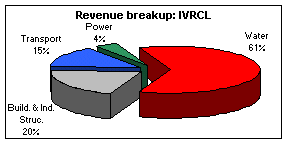
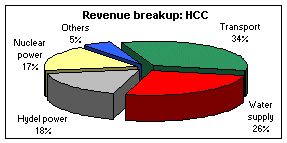
A look at the charts below makes it clear that HCC is a more diversified player than IVRCL. This is because the latter, though operating in four distinct segment, derives more than 60% of its revenues from the water segment, where it has presence into water desalinisation and supply kind of projects. In fact, the company is current executing the Rs 1,000 m Chennai Desalination Water Plant Project, which is supposed to be the largest of its kind in India. At the end of March 2006, IVRCL's order backlog stood at Rs 62.5 bn, almost 4 times its FY06 sales. Out of this backlog, the water segment contributes to 50% and the balance is distributed between roads (27%), building & structures (16%) and power (7%). Further, the management expects the order backlog to grow by 35%-45% in FY07. The company has especially stressed on its increasing focus in the power segment, whose contribution to the company's topline has increased from 3% in FY05 to 21% in FY06. In this segment, IVRCL has benefited from the government's thrust on improving the rural power situation through its Rajiv Gandhi Grameen Vidyutikaran Yojana.


Now, if one were to look at HCC's business mix (right hand pie chart), revenues are almost equally diversified into transport, water supply and hydel power segments, among others. In the transport segment, the company is especially focusing into BOT based projects, where margins tend to be relatively higher than the contract business.

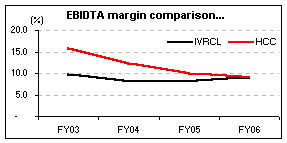
On comparing these two companies on financial parameters, while IVRCL has grown revenues and net profits compounded rates of 39% and 32% during the period FY02 to FY06, the growth for HCC has been 37% and 38% respectively. However, if one were to compare the profitability, IVRCL scores over HCC in terms of sustaining margins at the operating level. As seen from the adjacent chart, while EBIDTA margins for IVRCL have moved in a narrow range of 8% to 10% during FY03 to FY06, the same for HCC have declined from 16% to just over 9% during this period. Focus on relatively low margin road construction sector seems to have been the main reason for the declining margins of HCC. On the other hand, water treatment contracts earn better margins due to more complex execution and this has benefited IVRCL in the past. However, one must note that considering the influx of a large number of players into the construction space, companies have sacrificed margins to gain on volumes. The same is likely to continue in the future as well and, to that extent, profitability is likely to be impacted, for HCC and IVRCL alike.

Financial comparison (FY06)
(Rs m) IVRCL Infra HCC
Net Sales 14,957 20,241
EBITDA 1,343 1,843
EBITDA margins (%) 9.0% 9.1%
Other Income 57 38.1
Depreciation 110 542
EBIT 1,290 1,339
EBIT margins (%) 8.6% 6.6%
Interest 253 413
PBT 1,037 926
Tax 108 172.353
PAT 929 754
Net profit margin(%) 6.2% 3.7%
Diluted EPS (Rs) 8.7 3
P/E 26.1 36.7

Comparative valuations
At their respective current prices of Rs 227 and Rs 108, IVRCL and HCC are trading at price to earnings multiples of 26 times and 36 times their FY06 earnings respectively. These stocks have been beaten down tremendously in the latest stock market correction and valuations have dropped to reasonable levels. Going forward, while we remain positive on the growth prospects of the construction sector in general and these companies in particular, investors need to look beyond order book accretions and study at what profitability are these companies accruing new orders.


Monday, June 26, 2006

Kotak - Arcelor Mittal Positive


Download here

Sharekhan Eagle Eye - June 27


Download here

Sharekhan Investor's Eye - June 26


Download here

Kotak Securities - June 26


Download here

Thanks Puja

Sharekhan Commodities Buzz - June 26


Download here

ET - Picks for the week


Reliance Energy
Research: JM Morgan Stanley
Recommendation: Overweight
CMP: Rs 469 (Face Value Rs 10)
12-Month Price Target: Rs 526

JM Morgan Stanley rated 'overweight' on Reliance Energy with a one-year price target of Rs 526. Reliance Energy (REL), part of the Anil Dhirubhai Ambani Group, is one of India's premier integrated electric utilities, owning over 700 MW of generation capacity and distributing power in Mumbai, Delhi and Orissa.

REL also undertakes EPC business, via a separate division, which constitutes 17% of REL's operating profit. The promoters own 53.8% stake in REL, foreign holding stands at 18.6%. With financial assets comprising over 50% of REL's total assets, ROE is depressed and non-operating earnings comprise close to 75% of stand-alone pre-tax net profit.

There has been little progress on the implementation of its big ticket projects over the past 12 months and REL has been neither able to deploy a sizeable proportion of its cash chest in high-ROE projects, nor has the company paid out a chunk of the cash to shareholders.

Further, performance in its Delhi distribution business has been lacklustre and EPC division earnings arguably remain a wildcard. All these developments are reflected in the stock's performance – over the past 12 months, the stock is down 25% in absolute terms and has underperformed the BSE sensex by 67%.

The price target for the stock includes the value of REL's existing utility business (Mumbai and other IPPs), EPC business, Delhi distribution business (BRPL & BYPL), and net cash valued at 1.3x book. JM Morgan Stanley assume REL will invest 50% of its net cash and 75% of returns thereon in projects that generate an 18% ROE (invested cash), while the remainder (idle cash) generates an 8% return.

GlaxoSmithKline Pharma
Research: HSBC
Recommendation: Neutral
CMP: Rs 1,006 (Face Value Rs 10)
12-Month Price Target : Rs 980

HSBC Global Research upgraded the rating from 'underweight' to 'neutral' with a target price of Rs 980 in a year for GlaxoSmithKline Pharma. HSBC believes that the benefits from restructuring exercise for GSK India may largely be over and may only contribute marginally to earnings growth going ahead.

However, it notes several positives on the product development front. Only 29% of GSK's India's product portfolio is currently under price control as of '05 as against c40% in '01. 'Power brands' identified as key drivers early on have grown at rates much higher than industry.

In-licensing of products from global pharma companies (at least seven launches since '03) has enabled GSK India to expand its therapeutic coverage from anti-infectives to the more profitable chronic therapies. However, HSBC lowers their revenue forecasts by 4% for 2006E and by 5% for 2007E.

The decline in the forecasts mainly stems from the proposed disposal of the animal healthcare business which is effective from '06. The proposed disposal of the veterinary business and the potential divestures of the remaining non-pharma business is a positive as the profitability for these businesses is well below that for the pharmaceutical business.

Among MNC pharma companies in India, GSK India is ahead in terms of clearly outlining its strategy for the Indian pharma market as well as delivery. Given the significant correction in the share price recently, HSBC revises the rating from 'underweight' to 'neutral'.

Dwarikesh Sugar
Research: IDBI Capital
Recommendation: Buy
CMP: Rs 133 (Face Value Rs 10)
12-Month Price Target: Rs 230

Dwarikesh Sugar Industries (DSIL), a leading sugar player, has been rated 'buy' by IDBI Capital. DSIL is all set to capitalise on the demand supply gap in the international sugar markets through its aggressive expansion plan. It has ordered machinery for its third unit at Bareilly, UP, which will boost the total capacity to 21,500 TCD.

The proposed greenfield 7,500 TCD unit along with a co-gen plant of 36MW and additional 24MW cogeneration at Dwarikesh Puram, put together will cost the company around Rs.3,00 crore. The facility will be operational by the sugar season of '07-08. On account of the proposed expansion, the EPS is expected to grow to Rs 21.0 in FY07 and Rs.34.9 by FY08 from Rs.13.9 in FY06E.

Earnings are expected to expand further on account of the company's planned acquisition. The current market price discounts the FY07 EPS 8.9 times and FY08 EPS 5.4 times. The Indian sugar story has gone beyond the international boarders, as the international price has gone much above the domestic price owing to rising crude price and end of dumping by the EU.

Thus India is expected to emerge as a major international player in the sugar industry. With the combined effects of cost control measures, cane development, higher recovery and higher crushing the OPM (%) is improving year on year and is expected to stabilise at around 21% with the economies of scale arising out of expanded capacities, increased R&D and higher capacity utilisation.

Clutch Auto
Research: Emkay
Recommendation: Accumulate
CMP: Rs 120 (Face Value Rs 10)
12-Month Price Target: NA

Clutch Auto (CAL) is the largest maker of clutches and assemblies in the country with a market share of 60%. The company specialises in the heavy-duty segment which offers a decent scope both in the new as well as replacement market. CAL has tapped key players of the industry as its OE customers in the auto and tractor segments in India.

The exports of the company have been growing at a sturdy pace. CAL has entered into various agreements to market its products in the US and other international markets and has established a warehouse facility in the US to meet the growing demand. CAL exports to major American countries and expects to cater to more geographical locations.

Recently, CAL inked a JV with Pioneer - a leading US-based tractor component manufacturer to supply clutches and related components for the tractor market in the country. The American partner will supply products to original equipment manufacturers (OEM) as well as after market sales service through its 3,300 odd retail outlets across the North American market.

CAL supplies clutches to leading automakers in the country as well as abroad and its domestic clientele include prominent names like Tata Motors, Maruti, Escorts Tractors, M&M, etc. Clutches have a huge replacement market owing to the wear and tear of the hoses and plates.

CAL has penetrated across India and garnered a 30% market share in the replacement market. For FY06, the company has posted a 58% yoy rise in net sales to Rs 149.32 crore and margins remained steady at 15.9%. A lower tax and depreciation helped the net profit zoom 122% to Rs12.66 crore.

Exports contribution is on the rise and is likely to account for over 35-40% of the sales volume in the coming years. Factors like the recent ban on over loading is likely to aid growth in the CV industry and in return assist CAL's growth momentum.

The company is geared to improve performance both in the domestic and export markets over the coming years. Currently, the scrip is available at attractive valuations of 9.5x and 6.8x FY07 and FY08 estimated earnings respectively.

Sunday, June 25, 2006

Sharekhan Investor's Eye - June 23


Download here

Businessline Recommendations


Tata Tea - Buy

Ashok Leyland - Buy

Allahabad Bank - Buy

Nicholas Piramal - Buy

Nagarjuna Construction  - Buy

Mphasis - Buy

Saturday, June 24, 2006

Hotels: Hot streak continues!


In keeping with the FII flows, the Sensex rose from 3,000 points in May 2003 to its peak on May 10, 2006, up 420 per cent! Come May 12, 2006, the bearish sentiment triggered by a combination of factors, ranging from high inflation, rising global interest rates leading to FII outflows, higher crude oil prices and slower economic growth showed no signs of abating, as Indian equities succumbed to cues of weakness across major global markets. For the first time in calendar 2006, the BSE Sensex fell below the so-called support level of 9,000 levels (albeit with no support!). Though the markets have recovered to touch the 10,000 mark, the nervousness among participants is still prevailing.

Like all other sectors, hotel stocks too faced the brunt of the negative sentiment. Almost all stocks from the sector fell from the highs of 2006. The correction in these stocks has, in general, been in line with that of the benchmark index, the BSE Sensex. This can be seen in the chart below, with all the stocks in question – Indian Hotels, Taj GVK, EIH and Oriental Hotels - having lost more or less in line with the Sensex.

However, despite this fall, we continue to be bullish on the hotel industry prospects from a long-term perspective. For long-term investors, this seems to be a good opportunity to enter the markets and buy stocks at more reasonable valuations, as the fundamentals are still intact.

Foreign tourists still come knocking at India's door: India, as a favoured destination for foreign tourists, continues to roll. The inflow of the tourists for the period January 2006 to April 2006 has grown by 14.4% as compared to the corresponding period last year. The foreign exchange earnings are also up 16.3% YoY. The last year was a golden era for the hospitality industry with 3.9 m tourists visiting the country. This year we expect around 4.4 m tourists to visit India.

Upmove continues: Ten cities in India continue to play the role of perfect host this year. After ending FY06 at a phenomenal 41% YoY growth, both in terms of revenue per available room (RevPar) and average room rates (ARRs) across 10 key Indian cities, the hospitality industry's performance in April 2006 shows that growth is here to stay. During April 2006, RevPar in the premium segment in premier cities rose by 34% YoY. The RevPar growth was driven primarily by ARRs, which increased from Rs 5,592 in April 2005 to Rs 7,563 in April 2006, a growth of 35% YoY (Source: Cris Infac). Occupancy rates across these cities are also on the rise. Riding on a wave of unprecedented room rate realisations, even summer occupancies continue to run high, lessening the effect of seasonality on the hotels.

Visible expansion plans: Most of the hotel chains are expanding their room inventory. Indian Hotels along with its group companies is adding 2,000 rooms in the next couple of years. Hotel Leela has also drafted a blue print for expansion by increasing its room inventory by 50% at an estimated cost of Rs 14 bn. EIH's Mumbai property is also going to start operations by end of 2007. The foreign brands are not far behind. While Shangri-La is targeting 8 to 10 hotels by 2010, Dawnay Day, with an initial US$ 200 m investment, is planning to add 30 three- to four-star hotels in the next three to five years.

Conclusion
As we have indicated above, we are buoyant on the prospects of the Indian hospitality industry, both from the international and domestic tourism perspective. On the back of constrained supply, at least in the medium term, we expect occupancy levels and ARRs to remain robust across hotel properties. However, investors need to give adequate consideration to event risks (like economic slowdown and terrorist strikes) that might constrain this growth.
Equitymaster - Wochardt


Download here

Thanks Puja

Thursday, June 22, 2006